|
This new decal
sheet from Spada
Decals is the third in their series of decals that focuses on the Albatros
DIII and it includes
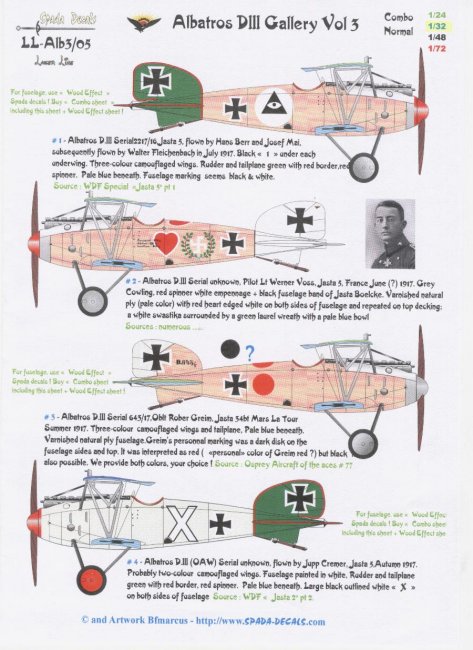
markings for 4 different 1/32 Albatros DIII in service with the Germany in 1917
during WW1. This sheet is also available in 1/72, 1/48 and 1/24.
You get a
colourful and attractive variety of aircraft in the wood and big markings from
this time period. You can pay €13 (Euros) for this decal sheet and get
addition wood grain decals which would probably be a big help finishing off the
wood grain finish on the fuselages on these aircraft. These decals are
printed on 2 sheets of decal film much like decals printed on an ALPS printer,
so you will need to cut each decal from the backing paper with the use of sharp
X-acto knife. The decals don't seem to be delicate as some of the decal
from other manufactures can be. More about using these decals can be found
further down in this review.
The planes
included on this decal sheet are the following:
-
Albatros
D.III Serial no. 2217/16, Jasta 5, flown by Hans Berr and Josef Mai and
subsequently flown by Walter Fleichenbach in July 1917.
-
Albatros
D.III Serial no. unknown, flown by Lt Werner Voss, Jasta 5, France in
June(?) 1917
-
Albatros
D.III Serial no.
643/17, Jasta 34bt, Mars La Tour in
the summer of 1917.
-
Albatros
D.III (OAW) Serial no.
unknown, flown by Jupp Cremer Jasta 5, in the Autumn of 1917.
Spada
Decals also has wood grain decals to assist you in building your WW1
fighter.
Click on
images below to see larger images
The instructions are mostly in
English and do include info about the markings and paint schemes on each
particular aircraft. You get one side profile of each aircraft with top
views of 2 aircraft. The decals are nice quality and are printed on
2 decal sheets. This decal sheet will permit you to make 1 of the 4
different aircraft featured on this decal sheet.
Here's some instructions from the
Spada
Decals website
regarding using and installing their decals.
How to use "Laser
Line" decals :
-
1- Using a new scalpel
blade, cut as closely as possible around the motives chosen, exercising only
a small pressure in order to cut the decal film but not the paper
underneath. This can be done quite
safely, with no danger to slip away, provided you stay calm and contentrated.
-
2- Separate the motive and
its paper background from the decal sheet, taking care not to damage the
other motives.
-
3- Put the decal on water,
with the motive on the upper side. It is not necessary to cover it with
water.
-
4- Let the paper soak water
for some 20 seconds or the time necessary according to the water used
(tepid water). With some practice, this can be determined quite accurately.
-
5- Remove the decal from
water and delicately take it away from its paper background, preferably
with tweezers.
-
6- Softly put the decal on
your model after the latter's surface has been carefully prepared, put it in
the correct place and slightly press it with a soft cloth or absorbing
paper.
A few useful details :
-
1- test your softening
liquid before using it. We have tested our decals with several brands that
are
available on the market but we haven't tried every one of them. In theory,
it is not necessary to varnish
decals before they are used.
-
2- It is possible for you
to enhance the sticking power of a decal using a specific product (e.g. Blue
Microscale). It is also possible for you to dilute white glue into water and
to put a drop of it under the decal or on the plastic part before the decal
is set on your model.
This is a fine decal sheet and
I must admit I have a romantic love of the fragile bi-planes and tri-planes of
the First World War with their colourful paint schemes and wood grains, so this
decal sheet is a treat to my eyes.
Steve
I would like to
thank Spada
Decals for
providing me with this review sample.
|
|