|
This is my second Wingnut Wings built following the Sopwith Pup (reviewed earlier). What seems to be the form of Wingnut Wings models, the Albatros kit has outstanding moulding
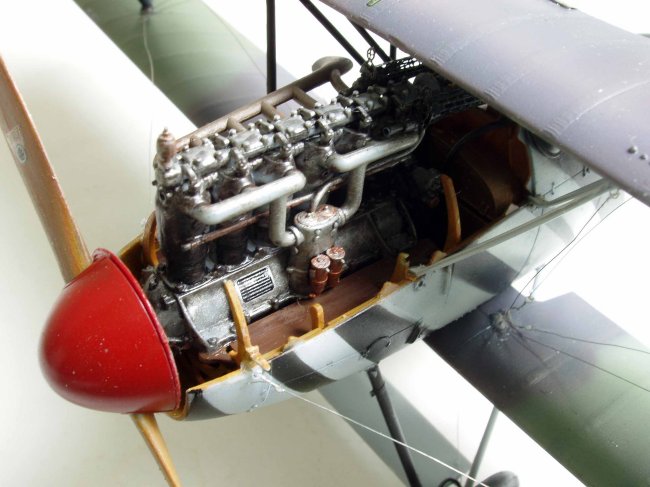
qualities starting with the detailed cockpit going with the engine and ending with the fine rendition of fabric on plastic.
During construction I found that the fit of parts is good and that the decals performed well by all accounts . By comparison to the Sopwith, the Albatros is somewhat easier to build as the model captures well the advanced aircraft design, meaning that you would build a model aeroplane as opposed to a flying machine. Hence, the attachment of wings and struts is not so tricky as you would find in many of early biplane designs. Furthermore, the option to have the engine cowlings removed to expose the fine details of the Daimler Mercedes engine is another bonus that makes this model even more attractive on your display area. In addition, the kit detailing of the Spandau machine guns with photoetch frets captures well one of the symbols of the Great War.
There are no reservations or critical issues concerning the kit except for one; I chose the attractive stripes scheme (D) for this model that also appears on the box cover. Having arranged the masking tapes according to the detailed instructions, I soon realized that it is an impossible geometric reality unless E.C. Escher himself had drawn the scheme on the aircraft. Since the fuselage is not cylindrical, the lines converge towards the tail and also the nose, thus changing width in contrast to the proposed color scheme.
Click on
images below to see larger images
Some points that may help you to build successfully this model:
- You may find at the Wingnut Wings site some construction tips, such as shaping the delicate frets for the machine guns and photographs that complement the building instructions.
- Attach control column firmly to the floor, especially if you plan to add the aileron control wires.
- It is better to include the propller disc on the engine shaft when you glue the engine into its cradle to get prop unit alignment right.
- You may drill the entry holes of the aileron control wires all the way to the top of the wing if you wish to have the tension retained on the wires. There is a cover part (P1) that will hide these holes.
- You may want to secure your scratch made turnbuckles to the designated holes before attaching the wings and struts.
In all, given that the model scale is just right, this highly detailed Albatros kit has the potential to be turned into a show stopper, but it will demand all your modelling skills and patience. Did I mention that rigging wires are not included?
I thank Wingnut
Wings for the review sample.
Rafi Ben-Shahar
Click on
images below to see larger images
|