| This is a follow
on from the Black
Hawk kit I reviewed earlier and much of it is the same but we do get a
whole new frame of parts specific to the Pave hawk. This contains a new
horizontal stabilizer, instrument panels, fuel cells, refuelling probe,
radome and various guns and fittings, even the main gear legs are replaced
and an alternative hoist is an added extra. Although the main airframe is
the same shape quite a different aircraft can be built from all this. |
| All the frames are moulded in a
light grey plastic with no flash what so ever and the clear parts are
perfect, the decal sheet reflects the nature of the beast with all low viz
black markings, there are some yellow stripes for the rotors and
thankfully Academy has thought to back these items up with a separate
white backing. The instruction booklet is very comprehensive and
construction should not be a problem for anyone. |
|
The MH-60G
is the aircraft theUSAF uses for Special Operations
support. Similar to the HH-60G with in flight refuelling and radar but the
MH has night and all weather capabilities and has a FLIR turret also, the
other standard feature is the provision for external stores pylons (ESSS),
it also has a folding stabilators hence the new parts in the kit. It seems
that the USAF operate sixteen of these plus another 82 HH-60Gs in the
combat rescue role.
|
| Construction
notes
Step 1 the
rotor hub assembly, take care when adding parts B56 they will not go at
the angle shown and if they did then parts D31 (the blade damper) would
not fit. In fact the whole piece is at the wrong angle as shown in a close
up photo in Sqadron Signal’s "Walk
Around" book. |
|
|
|
|
|
Step 3
the cabin ceiling part A3 is a little bare in this version and so I
decided to add some extra detail, I built the seat attachment bars from
strip and rod from the Plastruct fineline range and to these I added the
“Fast Rope” rings made from a bit of thick silver foil and some
telephone wire. The wire was wrapped several times around a suitable size
piece of rod, slid off the end and snipped with a pair of scissors to form
individual rings. These items are painted red and are used for those guys
to hook their abseil ropes
into as seen in “Black Hawk Down”.
|
|
Step 4
the pilots seats are very bare and some seat belts need making, I used
strips of foil from the wrappers on scalpel blades plus buckles from a
Reheat set of 1:32nd seat belt set. |
Step 7 before
adding anything to the cabin floor I sanded down the box around the cargo hook
bay until the floor sat in the body nice and level but remember to re establish
the slots for the hook itself. I made some additions to the underside of the
cockpit floor, there is lots of space there, and you can see from one side to
the other through the front windows so you need some panels to fill out the
void. Using 30thou plasticard I added two strips under each side around edge of
the step in the floor. When these were hard I drew a rough pencil mark on them
following the line of the fuselage then cut and sanded back until the floor
fitted nicely into the front of the fuselage, these were then given a few
lightening holes to enhance the appearance.
| |
| Step
10 before starting this section I decided to open the cockpit door
on the left side to show of some of the details inside so I cut the door
from the fuselage half, part A1, there is a “thin line” around the
door ready for this. It was then that I discovered that there is a
lot more to the door than just the outer shell. A good close up photo
revealed all the details so I started with a
sheet of 80 thou card cut roughly to the shape of the door, the
window and panel shapes were then drawn on in pencil and drilled and cut
out then cleaned up. This left me with a fairly pliable frame that I could
bend to the curvature of the door, next I sanded the outer edges to match
those of the interior lines and this was finally scraped with a knife
blade until the correct shape was acquired. Once cemented to the door the
framework had various rods and handles fitted plus the map pocket was made
from thick foil and superglued in place. The exterior hinges were removed
and new scraps of card added to make a better joint to the fuselage when
finally mounted. The exterior door handles were sliced off and remounted
in the horizontal position as seems to be the norm. |
|
Step
11 note the new panels for the intakes, these are quite delicate so
take care.
Step 12 it is important
not to get the HIRSS assemblies mixed up, they are handed but they will go
in on the wrong side and look odd. |
| Step 13
deals with a number of items, again don’t fit the cable cutters to the
legs until you have the wheels on, they WILL break off during
construction. The starboard sponson which houses the IFR probe needs a
step for the drivers to climb in with, I used the tread plate cut from the
spare part A15 and added it to an “L” shaped bracket cut from 30thou
card. |
|
| Next
item was the IFR probe, although nicely moulded; it lacks some details so
I decided to replace the whole thing with aluminium tubing. First I cut
the detailed nozzle from the kit part and put it to one side, and then I
selected the correct size tube to match the kit pipe plus two sizes down (these
all fit inside each other). The largest was cut to the length of
the kit part and two 3mm rings cut from the next size down, the smallest
tube was cut to 83mm long and one of the rings was superglued onto one end
of it, the opposite end had a plug
of suitable sized tight fitting sprue inserted to provide a key for the
nozzle to be cemented to and left to harden. The other ring was glued
flush into one end of the large tube to act as a stop and the smaller tube
was inserted from the other end and pushed right through to the stops.
Again as tight fitting piece of sprue was selected to insert at the rear
end of the large pipe, back to it’s closed position and the plug was
then inserted to meet it to act as the stop (you could loose it otherwise)
leaving appx 10-15mm outside to glue into the sponson and hold it all
level. A new bracket will have to be made to replace part G29 but that is
just a plastic ring and two stays, easy peasy. Add the wiring and
tiny blocks
of scrap plastic and there you have a working IFR |
|
|
|
Step 14 add parts B12/13 but
don’t add the HIRSS units until after painting is done.
Step 16 parts D21 are best
mounted with the bottom of the L shaped angle facing inboard, not as shown, they
will then fit the cover part B52 a lot better.
The remainder of the construction is straightforward
giving you a choice of configurations,
|
|
I built both rescue
hoists and all the guns and mounts but they were not all used, I did pose
some for photos but these were only fixed in with PVA which is easy to
break away later. I also wanted to use the spare ESSS pylons from the
Black Hawk kit so these were assembled and added after painting (it was a
lot easier)
|
| The kit miniguns, which are
fully adjustable, lack the shell ejection chute as seen in many photos so
I made them up from bare telephone wire tightly coiled around a 2.3mm
drill bit appx 40mm long, When this was slipped off it was bent to shape
and coated in PVA glue and left to set, this formed a nice covering to
paint black. One end of
the coil had a small length, 2mm, straightened out and inserted in a tiny
hole drilled in the gun, quite effective I thought. |
|
Painting and
decals
I have used the camouflage
drawings provided in the instruction sheet which aren’t perfect (some bits do
not join up) but I understand that the choppers are now painted overall dark
grey but you will have to find your own reference for that.
The cockpit glass areas were masked using Sellotape (scotch
tape) but I left the glass parts out of the cabin doors and gunners windows,
which were masked from the inside with ordinary masking tape to shield the
interiors. These were then held loosely in position with Blu Tack or PVA glue,
as was the engine compartment's cover while I sprayed the camouflage on, this
made it easy to get the patterns all matching on the moveable parts.
I sprayed the light grey all
over first and the using a soft pencil I drew out the patterns as needed and
followed up spraying the colours freehand along those lines. The colours are all
listed with FS number references which you can find in your favourite makers
ranges, I have used Humbrol paints on my model simply because they are hard
wearing and quick drying. When all was dry I
removed all those moveable parts and touched in any bare areas then the whole
model had a couple of fine coats of Klear (Future) dusted on and then a single
thicker coat ready for decalling. Once the decals were on another coat of Klear,
to seal them in was added and finally a coat of Klear mixed with some Tamiya
Flat base, in 3 to1 proportions, was sprayed on lightly to bring the finish back
to a nice sheen.
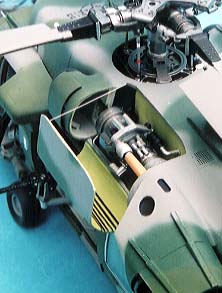
All the sub assemblies can now be
added to your choice but I had a problem with the cabin ceiling, in this and the
black hawk kit, with regards to mounting the rotor base part B59. Although I
double-checked the location of the floor in the fuselage sides it still left the
locating ring for the rotor base too far aft and it fouled the roof when
mounted. The only solution was to cut away the ring and mount the base in the
centre of the roof aperture, remembering to keep the forward slope on the base
sloping forward, this is only a tiny movement so don’t go overboard on it. The
rotor blades are a tight fit into the hub so I have not cemented mine and they
can be stowed away for transportation.
I think that covers everything, now, my opinion? Well it
provided hours of enjoyment with virtually no hassles and I have an excellent
model at the end of it. All the parts fitted without problems and there is no
filler anywhere, value for money? Certainly.
Ted
To see more of Ted
Taylor's models....go to
Ted
Taylor's Modelworks
|
|