|
Coastal Command's DeHavilland
Mosquito Mk VI
A couple of years back I got interested in the history of Coastal Command (CC)
operations against targets along the coast of Norway during WW2. (Comes
with my heritage. I'm Norwegian.. :-)
Compared to Fighter- and Bomber Command's achievements, Coastal Command's
struggles are somewhat unknown to the general public. Not many books are
available on the subject and the one's you'll find available are quite often
"insufficient" in their coverage from a modeller's point of view, with
mis-identifications in the photographs and the descriptions often being a bit
too vague when it comes to aircraft types, serials and squadrons. As my stack of
books on CC-action in/over Norwegian waters grows (right next to the evergrowing
pile of unbuilt kits) I feel that I'm just about to get under the surface...
only to discover that it's a long way to the bottom...
Enough with the metaphors.
Subject, goal, timespan...
A lot has been said on the Tamiya Mosquito in 1:48. I just think it's an
excellent kit. Period. In December '99, with the Norwegian National's in
February 2000 in mind, (Carrot needed to finish the kit) I got the Eduard
detail-set and MDC's camera-nose and started building, not having settled on
which scheme to paint my model in... Building was a breeze, and by late January
'00 I was getting to the point where I had to decide how I'd like to paint my
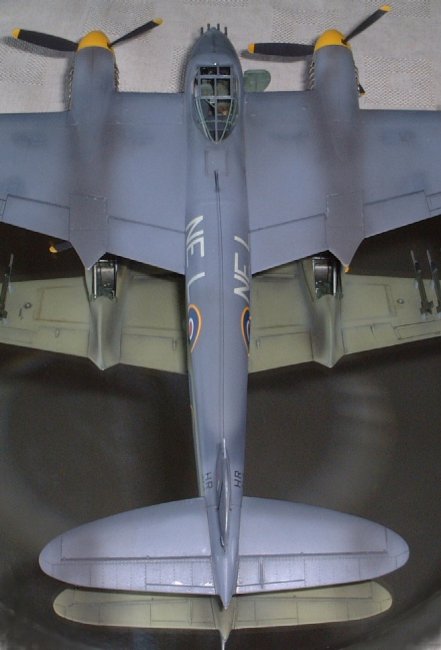
Mossie. I found a picture of a 143 Sqn machine in an issue of Wings Of
Fame reportedly taken in February '45, and the weathered and worn look of the
aircraft made the decision easy. A bit of research established the serial of
NE*L to be HR414.
At this point let me say a little
bit about the Strike Wings of Coastal Command:
Up until
September/October 1944, 235 and 248 and 333(N) Sqn's seems to have been
the only units of the Coastal Command using the Mosquito. They flew the
Mk VI and the cannon armed Mk XVIII along with the Beaufighter
squadrons.
Among them were 143 Sqn, using the Beaufighter XI in the escort/flak
suppression role, since they had no torpedo or rocket carrying
capabilities...
Most Strike Wings Squadrons were in the summer of '44 detached to
stations in South East England to assist in the pounding on the German
forces, many ships being sunk in close cooperation with the Royal Navy
on the West coast of France. |
|
Click on picture to see
larger picture |
 |
|
As the Allied
Forces got well inland all Strike Wings Squadrons were moved North with the
exception of 236 and 254 Sqn's who remained stationed at North Coates. By October
'44
the Beaufighter squadrons were established at Dallachy, while the Mosquito's
operated out of Banff, both stations being rather "rough" while
situated in the extreme North of
Scotland.
143 Sqn had by then converted to the Mossie, while the rest of the Strike Wings
units had to wait until the spring of '45 before they could lay their hands on
the 'Wooden Wonder'...
Their main targets were German shipping, their strike area stretching from the
Netherlands to Aalesund on the West coast of Norway. Their main targets were German shipping
stretching
from the Dutch coast to Aalesund on the West coast of Norway. And the losses
were heavy.
A standard attack would
feature two so-called "outriders", very often Mosquito's from
the Norwegian 333 Sqn, looking for suitable targets in the many fjords
and inlets. Once the target was found it didn't take long before the
main strike force approached, having been "on call"
offshore. Mossie's and Beau's would utilize 60lb rockets and 20mm
guns to suppress flak while dedicated "Torbeau's" from 144 and
489 Sqn's would come in low and try to drop their torpedo's while flying
a straight line among incredibly heavy flak and weaving friendly
aircraft. All the time with mountains stretching to 3000 feet in the air
close by on both sides. Very close by! In addition the (almost) ever
present JG 5 fighters of Stavanger, Herdla and Gossen took their toll...
|
|
Eventually CC found the usefulness
of torpedo's to be limited, seeing that the 25lb solid head rockets were more
effective. Perhaps not always in sinking the ships attacked, more so as a means
of stalling the Germans in their efforts to bring much needed supplies to the
Vaterland. A crippled ship occupies far more Kriegsmarine sailors than a sunken
one...
Uhm... back to modelling...
Strike Wings Mosquitos flew in two liveries: Either the factory applied
disruptive scheme of Medium Sea Grey (MSG) and Dark Green (DG), or the official
Coastal Command colours Extra Dark Sea Grey (EDSG) and Sky (S). (We'll lay
off that discussion about what colours were ACTUALLY used, won't we? :-)
Spinners were painted either EDSG,
MSG, S, Yellow, Black, Wine Red and I'm sure a lot of other colours. What's
quite evident is that the aircraft flew with different squadrons at different
times, dictating the fact that in order to paint one particular aircraft you
need an actual picture, preferably in colour, to make an accurate depiction...
What's so special about HR414
NE*L then?
The picture found didn't show the
spinners too well, and that meant I had to guesstimate on the colours used. Well
known colour pictures of 143 Sqn's NE*D shows a yellow/white spinner, so that's
what I went for.
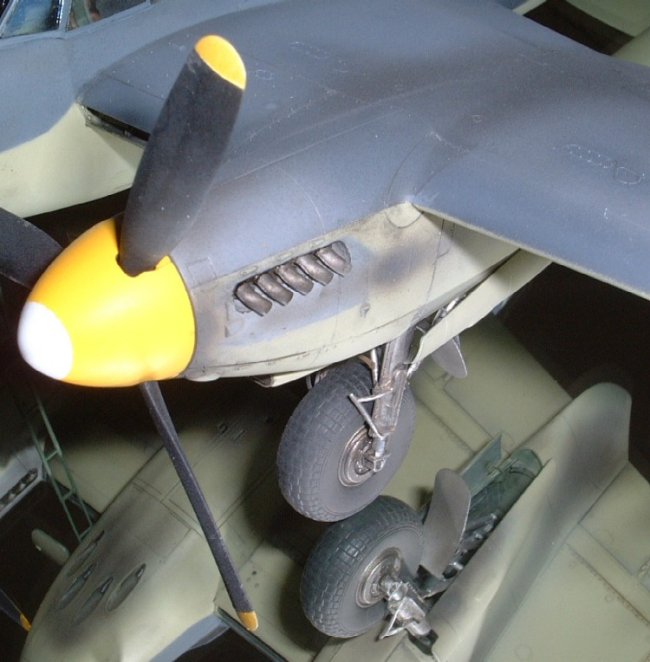
| In addition it seems that the
EDSG/S livery were painted at squadron/overhaul level, and I've seen
several pictures of aircraft with their exhaust covers removed after the
paintjob, showing the MSG colours underneath... So that I did too, using
the shrouds as masks when painting. Another thing quite apparent in the
picture of NE*L is that all Invasion Stripes have been painted over, the
fuselage one's fairly recently, showing a much "fresher" EDSG
around the roundel and the serial. Several touch-up's are also quite
evident. |
|
Click on picture to see
larger picture |
 |
|
Stripes away...
And this is where I'd like to say a few words on the appliance of the Allied
Expeditionary Force's Identification Stripes (or whatever they were called)
about which A LOT has been said and done. Here's what: The stripes was indeed
applied hastily just before the invasion, but were often touched up at a later
stage, and with aircraft arriving after the 6th of June the groundcrew seems to
have been far more careful when applying the paint (even using masks when
painting!). By the end of July the wing stripes were removed or overpainted, not
necessarily from all aircraft at once. By December the top of the fuselage
stripes were ordered removed, and in the beginning of January '45 all stripes
were supposed to be removed. That means that with aircraft taking part in the
action from June on, there will be several layers of EDSG or S. Looking at B/W
photo's with the EDSG apparently fading at different rates (due to red pigments
in the paint?) combined with de-icing fluids used on the canopy you would have
an aircraft looking as if it was painted in a disruptive camouflage! No wonder
we've seen so many "elaborate" examples of CC-camouflage through the
years... (Don't get me started on Beaufighter camo;-)
Exhausted subject...
On top of that the picture shows
extreme exhaust stains. My hypothesis is that the stains appeared during taxying
and take-off, while the engines were cold and a rich mix was used by the pilots.
Why? Because it seems that due to the slipstream of the propeller the staining
on the nacelles seems to "wrap" around the flaps when lowered and it
also seems to have darkened the top of the wing, something that would be almost
impossible during straight flight due to the low position of the exhausts. You
be the judge if I've overdone the staining on my model... (The judges in the
contest sure did.)
Markings:
The photo I found is supposed to have been taken in February '45, and I can
believe that, though at this time the wing markings were supposed to include the
white ring of the C-roundel. (Yes, my roundels are a tad too big. Don't ask..
sigh...) The identification letters of 143 Sqn should also have been painted in
black and yellow on each side of the fuselage roundels from (believed) January,
but other pictures shows a squadron line up with both sky and black/yellow
letters evident, so the date of the pic is still plausible. The only question I
then might have left would be if HR414 actually was operational at this
time?
| My two N's, E's and L's came
from an Aeromaster-sheet of Sky 36" letters, while the black
8" serials came from Xtradecals... I left out the "don't
walk" stripes on the wings, bearing in mind that the EDSG was
applied on top of factory stencilling. Should anyone have a picture
showing red walkway stripes on the wings of an EDSG-painted Mossie I'll
promptly go home and apply the decals! |
|
Click on picture to see
larger picture |
 |
|
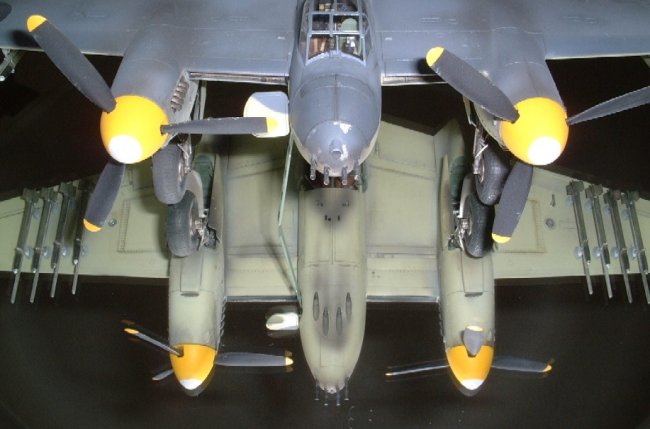
Who nose?
The MDC nose fit right in. Let me
add that I've still to find anyone but 143 Sqn Mossies with this type applied.
Most aircraft seem to have been fitted with the original nose with the offset
camera as supplied in the kit.
Kyrre
|
Click on picture to see larger
picture |
 |
|
|