|
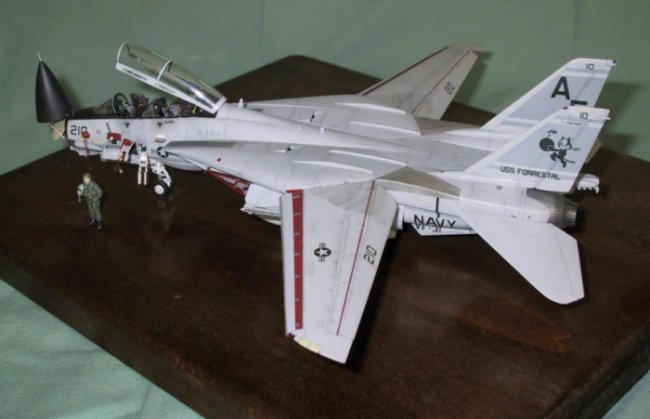
The model described in the following represents an
aircraft form the VF-31 “Tomcatters”, onboard the USS Forrestal.
The Hasegawa box already provides decal for VF-31 in the colorful version
with famous “Felix the Cat” on the red tail band.
Since I’ve always liked the F-14 in Tactical Paint Scheme (TPS), I was
inspired to reproduce the model in this less colorful but more “aggressive”
paint scheme from the pictures presented in the very interesting
Verlinden Lock-On volume n° 18 about F-14.
This required to custom make the decals for markings, codes and safety
indications around the cockpit, which were in gray on the decal sheet, while
should have been black on the aircraft; of course this included also
“Felix”, which was elaborated to eliminate the white areas from the head,
originally present in the box decal sheet.
The custom decals have been reproduced by means of a
photocopier (for those already available in the decal sheet); the safety
indications, the crew names and other stencils have been reproduced by means of
a PC drawing tool and printed by means of a laser printer.
click on
the images below to see the full size photo
|
 |
 |
Although the Hasegawa model is quite good already
“straight from the box”, as you can see I’ve performed some extra
detailing work.
The only aftermarket pieces in the model are the
ejection seats (Verlinden) and the intake screens; also them have been
elaborated with some extra details.
The cockpit has been detailed with particular respect
to the prominent canopy ejection handles, the rear cockpit support handle for
the WSO, the canopy locking devices and the ECS system ducts (fig.4).
The main area of scratchbuilding are the radar, the
gun bay and the ladder; also the red sensors protection covers and associated
red “streamers” are scratchbuilt (see image directly below); the radome has
been detailed as well to reproduce the locking devices and the support structs.
The bulkhead behind the radar has been detailed as
well (see image directly below), reproducing the different electrical connectors
and cables which are prominent in this area and their arrangement and
connections to the radar body and to the opened radome.
The
radar dish, the IFF array, the gimbal and the radar main body have been
completely scratchbuilt; also the complicated pattern of the wave guides behind
the radar dish has been reproduced (see image directly below);
all has been derived from plasticard and sprue.
Since I found difficult to bend and glue metallic wire
in the curves required for the radar area, and obtain a realistic look , I
decided to use a tiny rubber wire obtained by warming on a candle (as for
stretching the sprue) the insulating outskirt of an electrical cable (of course
black colour in this case); pulling apart gently is possible to obtain thin
segments of rubber wire, which does not oppose any resistance to bending and can
be glued in any position between
two connecting points (as you can see from photos).
|
The same technique has been used for having realistic
looking brake wires in the landing gears; you can see the main landing
gear on (on image directly to right) ; also the front and main landing
gears have been worked with extra details (the landing gear legs are the
poor aspect of the original kit, in my opinion). |
| click on
the image below to see the full size photo |
 |
|
|
Some extra detailing added some “life” to the
model, such as the typical opened engine servicing doors (on image
directly above), the different aperture of the nozzles (on image
directly to right), the “relaxed” position of the elevators, the
already mentioned sensors covers and streamers and a pilot figure. |
| click on
the image below to see the full size photo |
 |
|
The model TPS was airbrush painted with Gunze acrilics
(different shades of gray to obtain an uneven pattern, but no exaggerate), and
weathered with watercolours and pastels; particular attention was given to
reproduce the typical semicircular weathering produced by the
seal plates on the wing upper surface during the sweep movement, and to
the weathering of the inflated areas of the fuselage on which the wing rests
when in the full swept configuration.
Bye everybody!
Salvatore
|