|
That model had been sitting on the shelf for at
least seven years. In all that time, I had acquired a Black Box cockpit detail
set, an extra set of resin ejection seats, a photo etched fret from Eduard, and
no less than three sets of aftermarket decals. On several occasions, I removed
the model from the shelf, planning to build it. In each case, I just couldn't
bring myself to start it. The box was huge, and filled with a lot of plastic.
Apparently, I would need to be in just the right frame of mind to tackle this
monster.
Of course, the monster I'm speaking of, is
Hasegawa's 1/48th scale F-14A. Studying the kit while still in its
box, the level of detail appeared to be exquisite. Hasegawa had faithfully
reproduced even the smallest detail, resulting in no less than 200 parts. The
kit would no doubt be daunting, but the challenge, I was sure, was the result of
the kit's size and the number of parts.
Finally, a set of Aeromaster decals instilled in
me the necessary motivation to open the box and begin the project. Earlier, I
described this kit as a monster. That description stemmed from the kit's size. I
knew building the Tomcat would take some time, but because it was a Hasegawa
kit, I anticipated a project relatively free of pitfalls.
In hindsight, I think it would have been smarter
to leave the kit safely inside its box. I had completely misjudged the
complexity and difficulty associated with this model, and the definition of
monster, took on an entirely different meaning.
Hasegawa had duped me with this one, and I needed
to bring modeling skills to bear, infrequently needed when building one of their
kits. The project was, to say the least, an extreme challenge . I encountered
numerous fit problems including stepped joints, cavernous gaps, and extremely
complex building sequences. Adding insult to injury, I twice dropped the model
during assembly. Consequently, I had to repair a broken intake, and a shattered
nose cone. I probably should have heeded these omens as signs that the project
was not to be. The pitfalls; however, only hardened my resolve to finish the
model.
While it was a difficult project, the finished
product turned out to be quite pleasing, and in spite of the challenges, I now
have a very smart looking Tomcat that I can add to my 1/48th scale
collection.
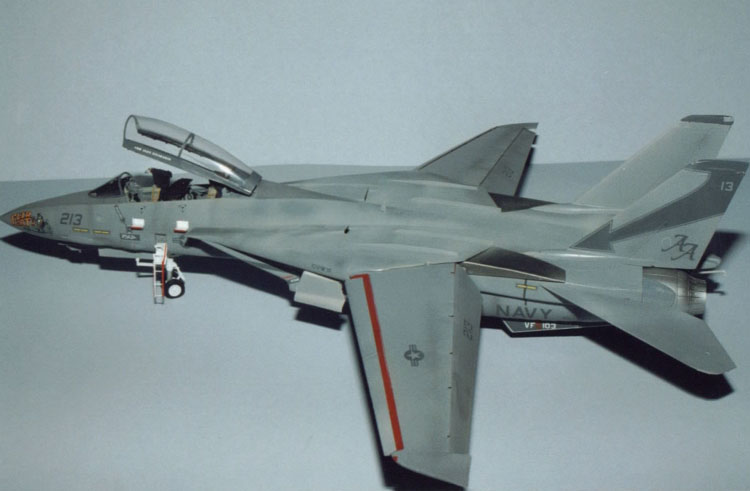
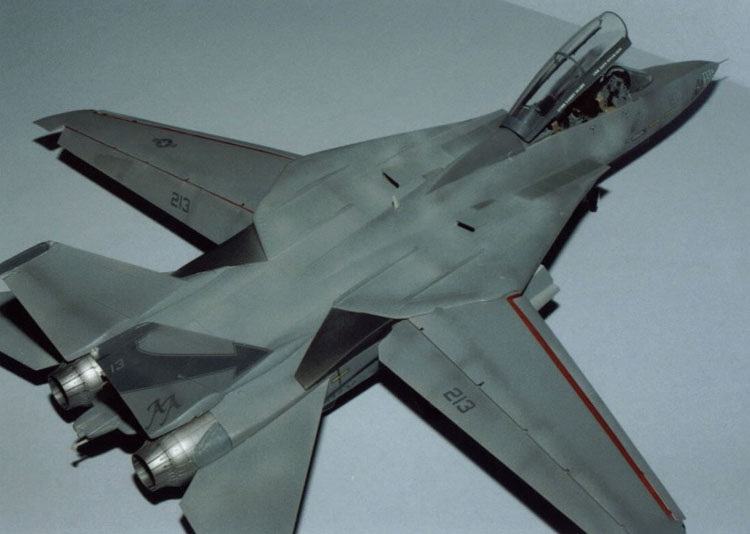
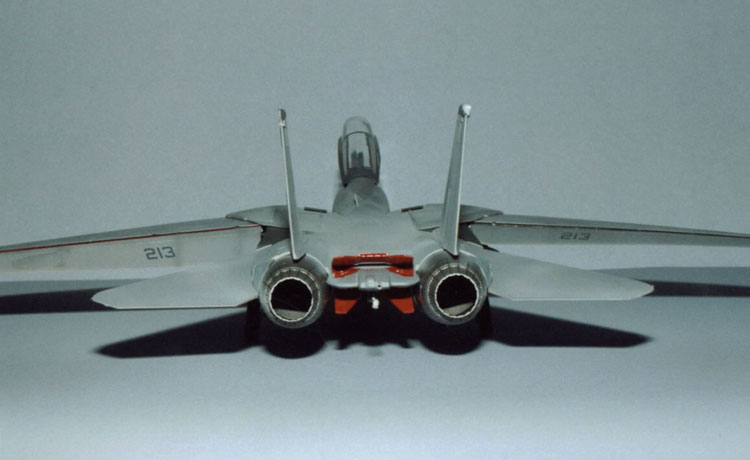
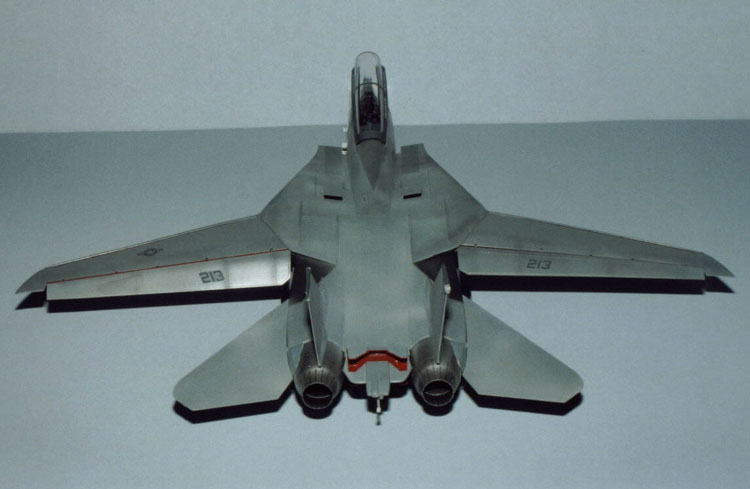
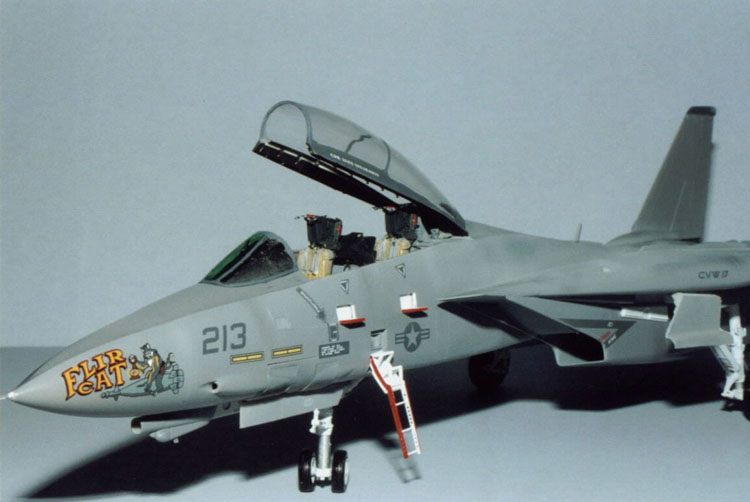
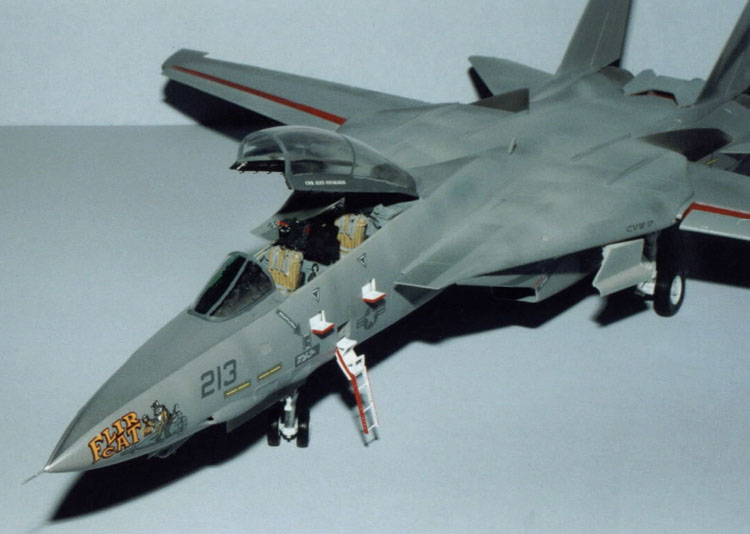
The paint scheme represents an F-14B of VF 103.
The aircraft is finished in an overall medium gray, which appealed to me because
it was much darker than the typical Tomcat scheme. This particular aircraft has
a FLIR targeting system upgrade and as it was a prototype, has the logo "FLIR
CAT" emblazoned on both sides of the nose. The decal sheet is one of
Aeromaster's new Tomcat sheets (48-435), and includes two large decal sheets.
This is one of the most colorful and interesting low visibility schemes you'll
find. The decals are large, and include the dark gray markings for the tail,
ventral strakes, and the nose and shoulder anti-glare panels. The decals are of
great quality, but because so many of them are extremely large, they were
difficult to settle successfully over all the raised and recessed surface
detail. Decal placement required numerous relief cuts and copious amounts of
setting solution. The decal difficulties added to an already challenging
project.
This Tomcat model, while leveled with exquisite
detail, and capturing the complex lines of the real thing, is not a kit for the
faint hearted. It requires a modeler's finest skills, and when successfully
tackled, results in a most accurate 1/48th scale F-14. Looking at the
kit settled on the shelf next to its Navy brethren, the project's difficulties
are easily forgotten. I guess I'm now ready to try Hasegawa's newer F-14D. After
all, I really am a glutton for punishment
Scott
(click on
the image below to load the full size photo)
|
|